


UPI Charges by Government in India 2026: Latest UPI Transaction Rules, MDR Charges & New Updates
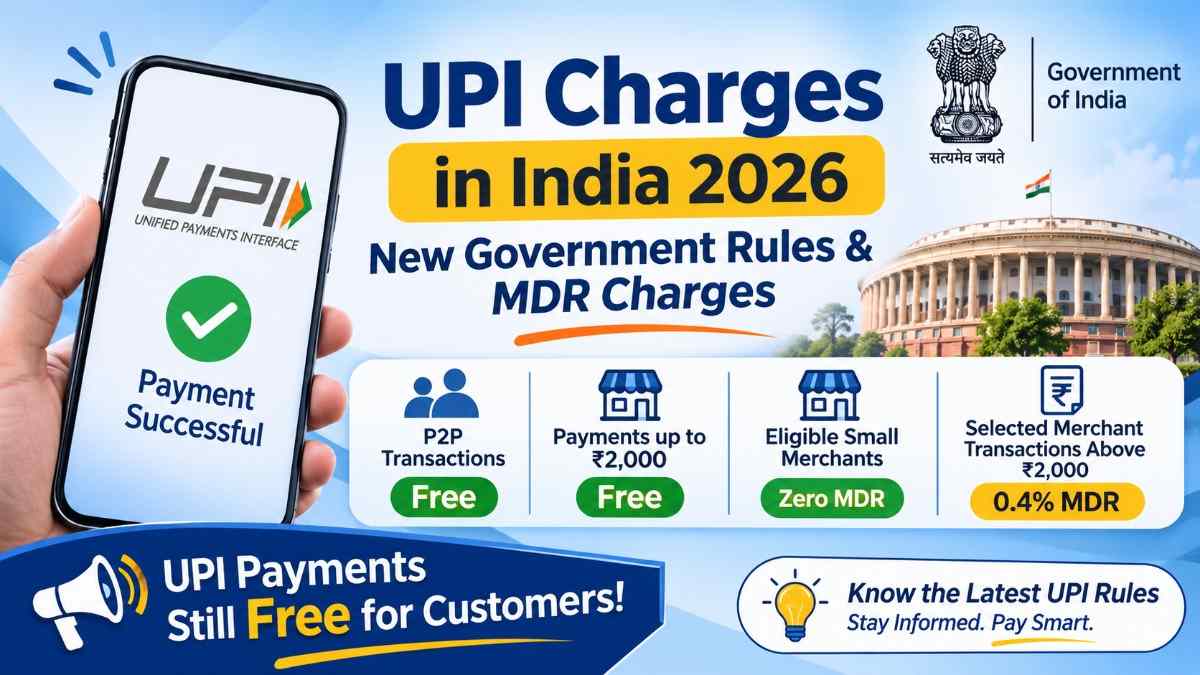
UPI Charges by Government in India 2026: Latest Rules, MDR Charges and Everything You Need to Know
Unified Payments Interface (UPI) has become one of the most popular digital payment methods in India. From making payments at local grocery stores to transferring money between bank accounts, millions of Indians use UPI every day because it is fast, convenient and secure.
However, discussions about new UPI charges introduced by the Government of India in 2026 have raised an important question: Will people now have to pay extra charges for making UPI payments?
The Government of India announced a new framework for Merchant Discount Rate (MDR) on selected UPI merchant transactions on 15 September 2026. This has created confusion among customers, shopkeepers, small business owners and digital payment users.
The good news is that ordinary customers will continue to enjoy free UPI transactions. However, selected merchant transactions may attract MDR charges under the new framework.
In this blog, we will explain the latest UPI transaction charges in India, government guidelines, merchant payment fees, free UPI transactions and how these changes affect customers and businesses.
1. What Are UPI Charges?
UPI charges refer to fees associated with processing digital payments through the Unified Payments Interface.
UPI was developed by the National Payments Corporation of India (NPCI) under the regulatory framework of the Reserve Bank of India (RBI).
It allows users to transfer money directly between bank accounts using a UPI ID, mobile number, QR code or other supported payment methods.
UPI transactions are generally divided into two categories:
Person-to-Person (P2P) Transactions:
These transactions involve transferring money from one individual to another, such as sending money to friends, family members or other bank account holders.
Person-to-Merchant (P2M) Transactions:
These transactions involve making payments to businesses, retailers, shopkeepers, online platforms and other registered merchants.
Understanding this difference is important because the latest 2026 government framework primarily concerns selected Person-to-Merchant transactions.
2. Is UPI Free in India in 2026?
Yes, UPI continues to be free for individual users making Person-to-Person payments.
Under the latest government guidelines:
-
Person-to-Person (P2P) UPI transactions remain completely free, irrespective of the transaction amount.
-
Merchant payments up to ₹2,000 remain free from MDR.
-
Eligible small merchants continue to receive payments without MDR under the applicable zero-MDR framework.
-
Customers are not required to pay additional UPI transaction charges.
-
UPI applications cannot impose additional platform fees or hidden charges under the announced framework.
According to the Ministry of Finance, approximately 96% of all Person-to-Merchant UPI transactions will remain unaffected by the new MDR framework.
Therefore, customers can continue using UPI for everyday digital payments without worrying about additional government transaction fees.
3. What Is the New UPI Charges Rule Introduced in 2026?
The Government of India announced a new Merchant Discount Rate (MDR) framework on 15 September 2026.
Under this framework, selected merchant transactions above ₹2,000 may attract MDR charges.
The main objective is to support the long-term sustainability of India's digital payment infrastructure while keeping everyday UPI payments free for individuals and protecting small businesses.
Here are the important changes:
-
UPI payments between individuals remain free.
-
Merchant transactions up to ₹2,000 remain free from MDR.
-
Selected merchant transactions above ₹2,000 attract MDR.
-
Eligible small merchants continue to receive zero-MDR benefits.
-
Special rates apply to selected essential sectors and capital market transactions.
It is important to understand that MDR is not a tax collected by the Government. It is a payment-processing fee distributed among eligible participants in the payment ecosystem, including banks and payment service providers.
4. Latest UPI MDR Charges in India 2026
The new government framework specifies different MDR rates depending on the merchant category and transaction type.
The following table explains the announced rates:
| Transaction Category | MDR Charges |
|---|---|
| Person-to-Person (P2P) | 0% |
| Merchant payments up to ₹2,000 | 0% |
| Eligible small merchants under P2PM | 0% |
| Selected merchant transactions above ₹2,000 | 0.4% |
| Selected essential-sector transactions above ₹2,000 | ₹5 per transaction |
| Capital market transactions | 0.02% |
Important MDR Limits:
-
For selected merchant transactions of ₹75,000 and above, MDR is capped at ₹300 per transaction.
-
For capital market transactions, MDR is capped at ₹300 per transaction.
-
Essential sectors include railways, telecommunications, insurance, fuel and agricultural inputs.
The applicable category and transaction conditions determine the actual MDR.
5. Who Has to Pay UPI Charges: Customers or Merchants?
One of the biggest concerns surrounding the new UPI rules is whether customers will have to pay additional fees when making digital payments.
According to the Ministry of Finance, MDR is a merchant-side payment-processing charge, not a customer transaction fee.
This means:
For Customers:
-
Sending money through UPI remains free.
-
Receiving money through UPI remains free.
-
Paying merchants up to ₹2,000 remains free from MDR.
-
Customers must not be charged additional MDR by merchants.
For Merchants:
-
Eligible small merchants continue to enjoy zero MDR.
-
Selected merchant transactions above ₹2,000 may attract MDR.
-
The applicable fee depends on the merchant category and transaction type.
Banks have also been advised to ensure that merchants do not pass MDR charges to customers.
Therefore, the new framework does not mean that customers must pay extra money every time they scan a UPI QR code.
6. What Is Merchant Discount Rate (MDR) in UPI?
Merchant Discount Rate (MDR) is a payment-processing fee associated with accepting digital payments.
When a customer makes a digital payment to a merchant, different participants help process and complete the transaction. These may include:
-
Customer's bank
-
Merchant's acquiring bank
-
Payment service providers
-
UPI application providers
MDR helps support the infrastructure and services required to process digital transactions.
Under the latest 2026 UPI framework, selected merchant transactions attract MDR to support the payment ecosystem.
Is MDR a Government Tax?
No. MDR is not a government tax. It is a payment-processing fee distributed among eligible participants in the digital payment ecosystem.
This distinction is important because MDR should not be confused with GST or other government taxes.
7. Why Has the Government Introduced UPI MDR Charges?
India's digital payment ecosystem has expanded significantly over the last few years.
Millions of individuals and businesses now depend on UPI for everyday payments. Maintaining this infrastructure requires continuous investment in technology, security, fraud prevention, transaction processing and payment services.
The new MDR framework aims to:
1. Support Digital Payment Infrastructure
Revenue from selected merchant transactions can help payment ecosystem participants maintain and improve their payment infrastructure.
2. Improve Payment Security
Digital payment systems require continuous investment in cybersecurity, fraud detection and risk management.
3. Support Payment Service Providers
Banks and payment service providers play an important role in ensuring smooth and reliable UPI transactions.
4. Protect Small Merchants
The zero-MDR provisions help protect small merchants and businesses from additional payment-processing expenses.
5. Encourage Sustainable Digital Payments
A sustainable payment ecosystem can support the continued growth and expansion of digital payments across India.
8. Will Small Shopkeepers Have to Pay UPI Charges?
No, eligible small merchants covered under the zero-MDR framework will continue to enjoy free UPI payment acceptance.
The latest framework specifically protects small merchants, including street vendors and neighbourhood shops.
Small merchants receiving up to ₹1 lakh per month through UPI QR codes under the applicable Person-to-Person-Merchant (P2PM) category continue to enjoy zero MDR on all their transactions.
This is particularly beneficial for:
-
Small grocery shops
-
Local retailers
-
Street vendors
-
Small business owners
-
Neighbourhood stores
-
Local service providers
The objective is to ensure that small businesses can continue accepting digital payments without additional MDR expenses.
9. Do High-Value UPI Transactions Attract Charges?
Yes, selected high-value merchant transactions may attract MDR under the new framework.
However, it is important to understand that the transaction amount alone does not determine whether a charge applies. The merchant category and applicable framework also matter.
For example:
-
A person transferring ₹10,000 to another individual through UPI will not pay MDR.
-
A customer making a merchant payment of ₹1,500 will not attract MDR.
-
A selected merchant transaction of ₹10,000 may attract 0.4% MDR.
-
An eligible small merchant covered by the P2PM zero-MDR framework continues to receive zero-MDR benefits.
Therefore, high-value UPI payments are not automatically chargeable in every situation.
10. Which Transactions Will Continue to Remain Free?
Even after the introduction of the new MDR framework, several common UPI transactions will remain free.
These include:
-
Sending money to friends and family.
-
Transferring money between personal bank accounts.
-
Receiving money from another individual.
-
Making merchant payments up to ₹2,000.
-
Eligible small merchant transactions under the zero-MDR framework.
The government estimates that approximately 96% of all merchant transactions will remain unaffected by the new MDR framework.
This ensures that the majority of everyday digital payments continue without additional payment-processing charges.
11. Difference Between UPI Charges, MDR and GST
Many people confuse UPI charges with MDR and GST. However, these terms have different meanings.
| Term | Meaning |
|---|---|
| UPI Charges | General term used for fees associated with UPI transactions. |
| MDR | Merchant Discount Rate, a payment-processing fee. |
| GST | Goods and Services Tax imposed under applicable tax laws. |
| Transaction Fee | A fee that may be associated with specific payment services. |
MDR is not itself a government tax.
Customers should also understand that the latest government framework does not permit merchants or UPI application providers to impose MDR on customers as an additional UPI payment charge.
12. How Will the New UPI Rules Affect Businesses?
The latest UPI framework is particularly relevant for businesses that accept digital payments regularly.
Large retailers, online businesses, payment aggregators and other merchant categories should understand the applicable MDR rules and review their payment-processing arrangements.
Businesses should consider:
-
Understanding their merchant category.
-
Checking whether their transactions fall under the MDR framework.
-
Reviewing payment-processing agreements.
-
Understanding applicable MDR rates and limits.
-
Maintaining transparent payment records.
-
Ensuring customers are not charged prohibited additional fees.
For businesses operating in the digital payment and fintech industry, understanding these guidelines is important for maintaining transparent and efficient payment operations.
13. Frequently Asked Questions (FAQs) About UPI Charges in India 2026
Q1. Is the Government charging money for UPI transactions in 2026?
No. The Government's latest framework does not introduce a general UPI transaction charge for customers. Selected merchant transactions may attract MDR, which is a payment-processing fee.
Q2. Will Google Pay, PhonePe and Paytm charge customers for UPI payments?
Under the announced framework, UPI application providers cannot impose additional platform fees or hidden MDR charges on customers for ordinary UPI payments.
Q3. Is UPI free for bank-to-bank transfers?
Yes. Person-to-Person UPI transfers remain completely free, irrespective of the transaction amount.
Q4. Is there any charge for receiving ₹10,000 through UPI?
No. Receiving ₹10,000 through an ordinary Person-to-Person UPI transfer remains free.
Q5. What is the MDR charge on UPI payments above ₹2,000?
A 0.4% MDR applies to selected merchant transactions above ₹2,000, subject to the applicable merchant category and special provisions.
Q6. Do small shopkeepers have to pay UPI charges?
Eligible small merchants covered under the P2PM zero-MDR framework continue to receive UPI payments without MDR.
Q7. Is MDR collected directly by the Government?
No. MDR is not a government tax or a fee collected by the Government. It is distributed among eligible payment ecosystem participants.
Q8. Will customers have to pay extra when scanning a shop's UPI QR code?
No. Merchants must not pass MDR charges on to customers under the announced framework.
Q9. Are all UPI transactions above ₹2,000 chargeable?
No. MDR applies only to specified merchant transactions. Person-to-Person transactions and eligible small merchant transactions continue to remain free.
Q10. What percentage of UPI merchant transactions will remain free?
According to the Ministry of Finance announcement dated 15 September 2026, approximately 96% of merchant transactions will remain unaffected by the MDR framework.
Conclusion: Are UPI Payments Still Free in India?
The latest UPI framework introduced in 2026 brings changes to the way selected merchant transactions are processed. However, it does not mean that ordinary UPI users will have to pay additional charges for everyday digital payments.
Person-to-Person transactions remain completely free, merchant payments up to ₹2,000 remain free from MDR, and eligible small merchants continue to receive zero-MDR benefits.
The new framework primarily introduces MDR on selected merchant transactions to support the long-term sustainability of India's digital payment infrastructure.
For customers, the key takeaway is simple: UPI payments remain free for everyday personal transactions, and MDR is not a customer-side government charge.
As digital payments continue to grow in India, staying informed about the latest NPCI, RBI and Government of India guidelines can help individuals and businesses make better financial decisions.
Stay updated with the latest digital payment, fintech and API industry developments with IDSPay.