


RBI Cybersecurity Guidelines 2026 for Digital Payment Companies: New Rules, API Security, Compliance & Latest Updates
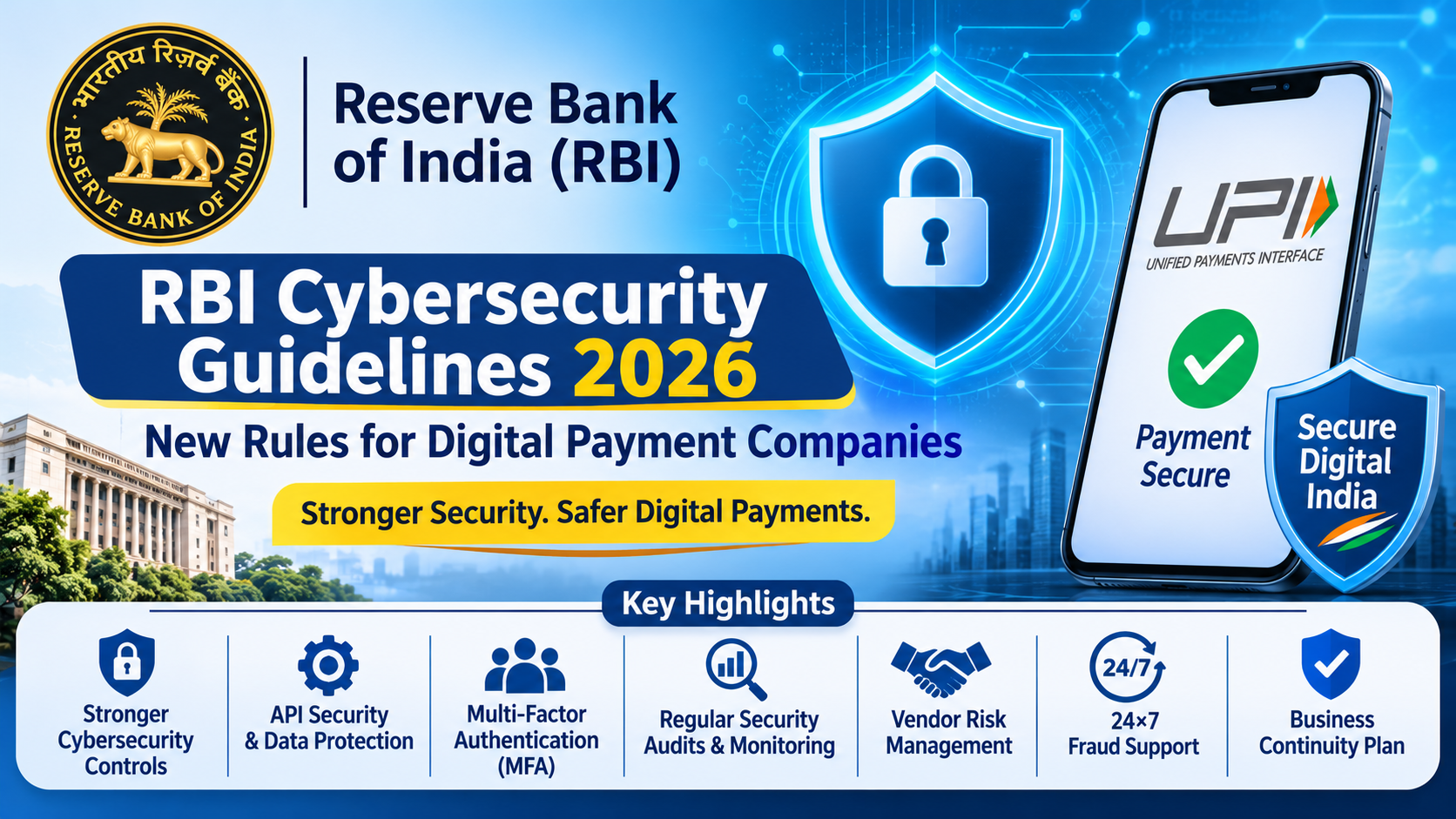
RBI Cybersecurity Guidelines 2026 for Digital Payment Companies: New Rules, API Security, Compliance & Latest Updates
India's digital payment ecosystem is growing rapidly. From UPI transactions and payment gateways to mobile banking, digital wallets and API-based financial services, millions of Indians now depend on digital platforms for everyday financial activities.
However, the increasing use of digital payment services has also increased cybersecurity risks, including online payment fraud, data breaches, unauthorised access, phishing attacks and API vulnerabilities.
To strengthen the security of India's digital payment infrastructure, the Reserve Bank of India (RBI) issued new Master Directions on Cyber Resilience and Digital Payment Security Controls for Non-Bank Payment System Operators (PSOs) on 5 November 2026.
These RBI cybersecurity guidelines establish a consolidated framework covering information security, API protection, customer data security, multi-factor authentication, security audits, vendor management and digital payment fraud prevention.
The new RBI guidelines are particularly important for authorised non-bank payment system operators, payment gateways, payment aggregators and other businesses participating in the digital payment ecosystem.
In this blog, we will explain the latest RBI cybersecurity guidelines 2026, their key requirements, implementation timelines and how they may affect digital payment companies and fintech businesses in India.
1. What Are the New RBI Cybersecurity Guidelines 2026?
The Reserve Bank of India introduced the Master Directions on Cyber Resilience and Digital Payment Security Controls for Non-Bank Payment System Operators, 2026, through its notification dated 5 November 2026.
The primary objective is to improve the security, reliability and resilience of payment systems operated by authorised non-bank Payment System Operators.
These directions consolidate earlier cybersecurity instructions and establish a common reference framework for managing information security and cyber risks.
The guidelines focus on several important areas:
-
Strengthening cybersecurity infrastructure.
-
Improving API security and authentication.
-
Protecting customer and financial information.
-
Preventing unauthorised digital transactions.
-
Introducing stronger vendor and third-party security controls.
-
Improving fraud detection and incident management.
-
Ensuring regular security audits and vulnerability assessments.
-
Maintaining business continuity during cyber incidents.
The RBI wants payment system operators to develop stronger security practices so that digital payment services remain safe, reliable and available.
2. Who Must Follow the RBI Cybersecurity Guidelines 2026?
The new RBI Master Directions primarily apply to all authorised non-bank Payment System Operators (PSOs).
These include eligible entities involved in operating or facilitating payment systems in India.
The framework is also relevant to third-party service providers, vendors and other unregulated entities connected to a PSO's digital payment ecosystem.
Under the guidelines, authorised PSOs must ensure that relevant third-party entities follow applicable security requirements through mutual contractual arrangements.
Businesses that should carefully review these guidelines include:
-
Payment Aggregators (PAs).
-
Payment Gateways.
-
Prepaid Payment Instrument (PPI) issuers.
-
Non-bank payment system operators.
-
Third-party payment technology providers.
-
Third-party ATM Switch Application Service Providers.
-
Technology vendors supporting payment infrastructure.
Important: These directions do not automatically apply to every fintech company or API service provider merely because it offers financial technology services. Applicability depends on the entity's regulatory status, activities and relationship with an authorised PSO.
Banks and other regulated entities may also be governed by separate RBI cybersecurity directions.
3. When Will the New RBI Cybersecurity Rules Become Effective?
One of the most important aspects of the new RBI guidelines is the implementation timeline.
The RBI has provided different effective dates depending on the size classification of the non-bank Payment System Operator.
| Category | Effective Date |
|---|---|
| Large Non-Bank PSOs | 5 November 2026 |
| Medium Non-Bank PSOs | 5 November 2026 |
| Small Non-Bank PSOs | 1 April 2028 |
The directions become effective for large and medium non-bank PSOs from the date they are placed on the RBI's official website.
Small non-bank PSOs have been given additional time to prepare their cybersecurity infrastructure and implement the required security controls.
Therefore, payment system operators should identify their applicable category and prepare an appropriate compliance plan.
4. Key RBI Cybersecurity Requirements for Digital Payment Companies
The new RBI cybersecurity framework covers several important security requirements.
Let's understand the major requirements that digital payment companies and authorised payment system operators should know.
4.1 Strong Cybersecurity Governance and Risk Management
RBI has made cybersecurity governance an important responsibility of the Board of Directors.
Payment System Operators must establish a proper information security framework to identify, assess, monitor and manage cybersecurity risks.
Key requirements include:
-
Establishing a Board-approved Information Security Policy.
-
Reviewing the information security policy annually.
-
Assigning cybersecurity responsibilities to senior management.
-
Monitoring cybersecurity risks regularly.
-
Conducting risk assessments before introducing new products or technologies.
-
Maintaining appropriate Key Risk Indicators (KRIs) and Key Performance Indicators (KPIs).
The Board's designated cybersecurity oversight committee must meet at least once every quarter.
This ensures that cybersecurity is treated as an important business responsibility rather than only a technical department's responsibility.
4.2 Multi-Factor Authentication (MFA) for Digital Payments
Multi-Factor Authentication (MFA) is one of the most important security measures covered under the new RBI directions.
MFA requires users to validate their identity using multiple authentication factors before completing certain activities or transactions.
Examples include:
-
Password or PIN.
-
OTP verification.
-
Device-based authentication.
-
Other approved authentication factors.
Under the new framework, payment transactions involving a debit to an account through electronic modes must be validated using multi-factor authentication, except where RBI has explicitly permitted or relaxed the requirement.
The objective is to reduce unauthorised transactions and improve payment security.
Payment operators must also establish strong authentication controls for privileged user accounts.
4.3 Mandatory API Security Requirements
API security is especially important for businesses offering digital payment services and financial technology solutions.
APIs allow different applications, platforms, banks and payment systems to communicate and exchange information.
However, insecure APIs can expose sensitive information and create opportunities for cyberattacks.
The new RBI guidelines specifically address API security and require Payment System Operators to implement appropriate controls.
The major API security requirements include:
Authentication and Authorisation
Payment operators must establish the identity of applications communicating through APIs and ensure that only authorised applications can access permitted resources.
Data Confidentiality
API communication must protect sensitive information against unauthorised access and tampering.
Data Integrity
Payment information and other resources transferred through APIs must remain accurate and reliable.
Availability and Threat Protection
APIs must remain available when required, and unusual or suspicious activities must be identified and addressed.
Payment operators must also follow relevant standards and globally recognised API security frameworks.
These requirements highlight the importance of secure API development, authentication mechanisms, access management and continuous monitoring.
4.4 Regular Security Audits and Vulnerability Assessment
RBI has emphasised regular security testing to identify vulnerabilities before attackers can exploit them.
Payment System Operators must ensure that their applications undergo security testing through qualified professionals.
Important security testing activities include:
-
Vulnerability Assessment (VA).
-
Penetration Testing (PT).
-
Source Code Review.
-
Application Security Testing.
-
Infrastructure Security Testing.
The directions require application security testing at least annually.
Additionally, critical applications and infrastructure must undergo appropriate security audits before deployment or redeployment.
Any vulnerabilities identified during security testing must be addressed within a defined timeframe.
This requirement helps organisations identify security weaknesses and improve the reliability of their payment infrastructure.
4.5 Customer Data Protection and Encryption
Protecting customer information is another major focus of the RBI cybersecurity guidelines.
Digital payment companies handle sensitive information, including personal details, financial information and transaction records.
Any unauthorised access or data leakage can create serious risks for customers and businesses.
Under the new guidelines, payment operators must implement appropriate data security measures.
These include:
-
Protecting customer information against unauthorised access.
-
Implementing data loss prevention policies.
-
Maintaining confidentiality and integrity of information.
-
Encrypting data during transmission and storage.
-
Implementing secure application and database controls.
-
Protecting Personally Identifiable Information (PII).
-
Testing backup data recovery at least every six months.
Payment System Operators storing debit, credit or prepaid card data must also comply with applicable PCI-DSS requirements and obtain the required certification.
4.6 Third-Party Vendor and Outsourcing Security
Payment companies frequently depend on external vendors, technology providers, cloud platforms and payment infrastructure partners.
However, security weaknesses in third-party systems can also create risks for the main payment operator.
To address these risks, RBI has introduced specific vendor risk management requirements.
Payment operators must:
-
Implement security controls to prevent unauthorised access through vendor environments.
-
Assess the cybersecurity capabilities of critical vendors.
-
Ensure that vendors follow relevant data protection and regulatory requirements.
-
Obtain independent auditor assurance for the cyber resilience capabilities of vendors involved in critical processes.
-
Establish appropriate contractual security obligations.
This means cybersecurity responsibilities must extend beyond an organisation's internal IT infrastructure.
4.7 Real-Time Fraud Monitoring and Incident Reporting
Detecting suspicious transactions quickly is essential for preventing digital payment fraud.
The new RBI directions require payment operators to implement real-time or near-real-time fraud monitoring solutions.
These systems should identify suspicious transaction patterns and generate appropriate alerts.
Some important requirements include:
-
Monitoring unusual transaction activities.
-
Identifying suspicious payment behaviour.
-
Detecting potentially unauthorised transactions.
-
Maintaining an incident response mechanism.
-
Coordinating with relevant authorities.
-
Conducting post-incident investigations.
Important Incident Reporting Requirement:
Unusual incidents, including cyberattacks, critical infrastructure outages, internal fraud and settlement delays, must be reported to RBI within six hours of detection using the prescribed reporting format.
Cybersecurity incidents must also be reported to CERT-In.
This requirement highlights the importance of rapid incident detection, escalation and response.
4.8 24×7 Customer Support for Fraudulent Transactions
Digital payment fraud can happen at any time, including outside normal business hours.
To improve customer protection, the RBI guidelines require Payment System Operators to maintain a manned facility operating 24 hours a day, 7 days a week and 365 days a year.
This facility must support:
-
Swift resolution of reported unauthorised transactions.
-
Assistance with fraudulent transaction complaints.
-
Coordination with law enforcement agencies.
-
Prompt responses to customer-related fraud incidents.
The objective is to ensure that customers can report suspicious or fraudulent transactions without waiting for regular business hours.
4.9 Business Continuity and Disaster Recovery Planning
A cyberattack, system failure or infrastructure disruption can interrupt payment services.
For this reason, RBI requires payment operators to establish a comprehensive Business Continuity Plan (BCP).
The plan should explain how critical payment services will continue or resume following unexpected disruptions.
Important requirements include:
-
Maintaining a documented Business Continuity Plan.
-
Reviewing the plan at least annually.
-
Establishing a Disaster Recovery (DR) facility.
-
Maintaining defined Recovery Time Objectives (RTO) and Recovery Point Objectives (RPO).
-
Conducting Disaster Recovery drills at least every six months.
-
Ensuring appropriate data reconciliation during service recovery.
The Disaster Recovery facility must be located in a different seismic zone from the Primary Data Centre.
These measures help reduce downtime and protect transaction information during unexpected incidents.
4.10 Cloud Security and Infrastructure Protection
Many digital payment businesses depend on cloud infrastructure to manage applications, databases and payment-related services.
The new RBI guidelines require Payment System Operators using cloud services to maintain an appropriate cloud operations policy.
This policy should cover:
-
Responsibilities of the Cloud Service Provider (CSP).
-
Data localisation requirements.
-
Data protection and recovery.
-
Access control mechanisms.
-
Customer information security.
-
Protection against data mixing in multi-tenant environments.
Cloud Service Providers must also undergo independent information and cybersecurity audits at least annually.
The relevant Board committee must review audit reports and the provider's cybersecurity capabilities.
5. New RBI Guidelines for Mobile Payment Security
The RBI has also specified security measures for payment operators providing or facilitating mobile payment services.
These requirements aim to protect mobile payment applications against unauthorised access and suspicious activities.
Important requirements include:
Device Binding
Mobile payment applications must implement device binding or device fingerprinting with the registered device and SIM.
Secure Login Sessions
Authenticated sessions and encryption protocols must remain secure throughout customer interactions.
Automatic Session Termination
Mobile payment sessions should automatically terminate after a defined period of inactivity.
Failed Login Protection
Payment applications must establish limits for failed login or authentication attempts and notify customers about failed attempts.
Remote Access Application Detection
Payment operators must implement controls, to the extent possible, to identify remote access applications and prevent access to mobile payment applications while remote access is active.
Cooling Period After Mobile Number or Email Changes
A minimum cooling period of 12 hours must be maintained after a change in the registered mobile number or email ID linked to the payment instrument before allowing online payment transactions.
These requirements aim to improve mobile payment security and reduce the possibility of account misuse.
6. Mandatory System Audit Requirements Under RBI Guidelines
The new RBI Master Directions also specify annual system audit requirements for authorised Payment System Operators.
The system audit must be conducted by an eligible auditor, such as:
-
A CERT-In empanelled auditor.
-
A Certified Information Systems Auditor (CISA) registered with ISACA.
-
A holder of the Diploma in Information System Audit (DISA) qualification issued by ICAI.
The System Audit Report must be submitted annually within two months of the close of the financial year.
For entities following an April–March financial year, the report must be submitted by 1 June.
The audit should cover areas such as:
-
Information Security Governance.
-
Access Control.
-
Hardware Management.
-
Network Security.
-
Data Security.
-
Business Continuity.
-
Vendor Risk Management.
-
Incident Management.
-
Change Management.
-
Patch Management.
-
API and Application Security.
-
Security Testing.
Any open audit observations must be addressed through time-bound corrective actions, with a maximum period of three months for corrective action as prescribed in the directions.
7. How Will the New RBI Cybersecurity Rules Affect FinTech Companies?
The new RBI guidelines are particularly important for the Indian fintech industry because digital financial services depend heavily on secure technology infrastructure.
Businesses providing payment processing, digital wallets, payment gateways and other payment-related services must understand their regulatory responsibilities.
The key areas of impact include:
Improved API Security
Businesses participating in regulated payment ecosystems may need stronger API authentication, authorisation, encryption and monitoring mechanisms.
Better Customer Data Protection
Payment operators must strengthen the protection of sensitive customer information.
Increased Security Testing
Regular vulnerability assessments, penetration testing and application security reviews become important compliance activities.
Stronger Vendor Management
Technology partners and third-party service providers may need to meet additional contractual security requirements.
Better Fraud Prevention
Payment operators must improve fraud detection and incident response capabilities.
Improved Business Continuity
Organisations must prepare for unexpected cybersecurity incidents and infrastructure failures.
Overall, these requirements encourage a more secure and reliable digital payment ecosystem in India.
8. RBI Cybersecurity Compliance Checklist for Digital Payment Companies
Digital payment companies and authorised Payment System Operators can use the following checklist to review their cybersecurity preparedness.
| Security Area | Important Requirement |
|---|---|
| Information Security | Board-approved security policy |
| Cyber Governance | Quarterly Board committee oversight |
| Authentication | MFA for applicable payment transactions |
| API Security | Authentication, integrity and threat protection |
| Security Testing | Application security testing at least annually |
| Data Protection | Encryption and data loss prevention |
| Vendor Management | Third-party cybersecurity assessment |
| Fraud Monitoring | Real-time or near-real-time monitoring |
| Incident Reporting | RBI reporting within six hours for specified incidents |
| Customer Support | 24×7 manned fraud response facility |
| Audit Logs | Minimum five-year preservation |
| Disaster Recovery | DR drills at least every six months |
| System Audit | Annual independent system audit |
This checklist provides a practical overview of the major requirements. Organisations should refer to the complete RBI Master Directions to determine their exact compliance obligations.
9. Why Are These RBI Cybersecurity Rules Important for India's Digital Payment Ecosystem?
India has become one of the world's leading digital payment markets.
The increasing adoption of UPI, payment gateways, mobile applications and API-based financial services has made secure payment infrastructure more important than ever.
The latest RBI cybersecurity guidelines aim to address several challenges.
1. Prevention of Digital Payment Fraud
Improved authentication, transaction monitoring and fraud detection can help identify suspicious activities.
2. Protection of Customer Information
Strong encryption and data protection measures help reduce the risk of sensitive information being exposed.
3. Stronger API Infrastructure
Secure APIs help protect communication between payment applications and financial systems.
4. Improved Trust in Digital Payments
Reliable payment infrastructure can increase confidence among customers, merchants and businesses.
5. Better Cyber Resilience
Disaster recovery planning and incident management help payment operators maintain critical services during disruptions.
These measures support the long-term growth and security of India's digital financial ecosystem.
10. What Should Payment Companies Do Next?
Following the release of the new RBI cybersecurity directions, authorised Payment System Operators should begin reviewing their existing security frameworks.
Here are some recommended steps:
-
Identify the applicable RBI regulatory category of the organisation.
-
Review existing information security and cybersecurity policies.
-
Conduct an internal cybersecurity gap assessment.
-
Review API authentication and access control mechanisms.
-
Evaluate third-party vendors and technology partners.
-
Strengthen data encryption and customer information protection.
-
Conduct vulnerability assessments and penetration testing.
-
Review fraud monitoring and incident reporting processes.
-
Test disaster recovery and business continuity arrangements.
-
Prepare an implementation roadmap for applicable compliance requirements.
Businesses should also review their contractual arrangements with technology vendors and service providers to ensure that relevant cybersecurity responsibilities are clearly defined.
11. Frequently Asked Questions (FAQs) About RBI Cybersecurity Guidelines 2026
Q1. What are the new RBI cybersecurity guidelines 2026?
The RBI cybersecurity guidelines 2026 are the Master Directions on Cyber Resilience and Digital Payment Security Controls for Non-Bank Payment System Operators, issued on 5 November 2026. They establish security requirements covering information security, API protection, data security, authentication, fraud monitoring and system audits.
Q2. When did RBI issue the new cybersecurity guidelines?
The Reserve Bank of India issued the new Master Directions on 5 November 2026.
Q3. Who must follow the RBI cybersecurity guidelines 2026?
The directions apply to all authorised non-bank Payment System Operators (PSOs). Relevant third-party vendors and service providers must also adhere to applicable requirements through contractual arrangements with PSOs.
Q4. Are the new RBI cybersecurity guidelines applicable to payment gateways?
Authorised non-bank Payment System Operators must comply with the applicable directions. Payment gateways and other third-party service providers connected to a PSO may also need to follow relevant security requirements under contractual arrangements. Applicability depends on their regulatory status and activities.
Q5. What are the new RBI guidelines for API security?
The RBI requires payment operators to implement API authentication and authorisation, confidentiality, data integrity, availability and threat protection measures. They must also follow relevant API security standards and globally recognised frameworks.
Q6. Is multi-factor authentication mandatory under the new RBI guidelines?
The directions require applicable electronic payment transactions involving a debit to an account to be validated through multi-factor authentication, except where RBI has explicitly permitted or relaxed the requirement.
Q7. What is the incident reporting timeline under the new RBI rules?
Specified unusual incidents, including cyberattacks, critical system outages, internal fraud and settlement delays, must be reported to RBI within six hours of detection. Cybersecurity incidents must also be reported to CERT-In.
Q8. What is the minimum audit log retention period under the new RBI guidelines?
Authorised Payment System Operators must preserve audit logs for at least five years.
Q9. How often should payment companies conduct security testing?
Applications must undergo security testing at least annually. Additional security audits are required before deployment or redeployment of services supporting critical functions and infrastructure.
Q10. When will the new RBI cybersecurity guidelines become applicable to small payment operators?
The directions become applicable to small non-bank Payment System Operators from 1 April 2028.
Q11. What are the new RBI rules for Disaster Recovery?
Payment System Operators must establish a Disaster Recovery facility in a different seismic zone from their Primary Data Centre and conduct Disaster Recovery drills at least once every six months.
Q12. Do these RBI cybersecurity rules apply to every fintech company in India?
No. The directions directly apply to authorised non-bank PSOs. Other fintech companies may have obligations under separate regulatory frameworks or through contractual arrangements with authorised payment operators.
Conclusion: How RBI Cybersecurity Guidelines 2026 Will Strengthen Digital Payments in India
The Reserve Bank of India's new Cyber Resilience and Digital Payment Security Controls Master Directions, issued on 5 November 2026, represent an important development for India's digital payment ecosystem.
By introducing a consolidated framework covering API security, multi-factor authentication, customer data protection, security audits, vendor management, fraud monitoring and disaster recovery, RBI aims to strengthen the overall security and reliability of payment systems.
For authorised non-bank Payment System Operators, understanding and implementing these requirements will be essential.
Technology vendors, payment gateway partners and fintech businesses connected to regulated payment operators should also review their security practices and contractual responsibilities.
As India's digital payment industry continues to expand, cybersecurity, regulatory awareness and secure API infrastructure will play an increasingly important role.
Stay updated with the latest RBI regulations, fintech developments, digital payment updates and API technology insights with IDSPay